
Why I Stopped “Edtech Coaching”
A moment of obligation is when you see something so fundamentally wrong that you can’t unsee it.
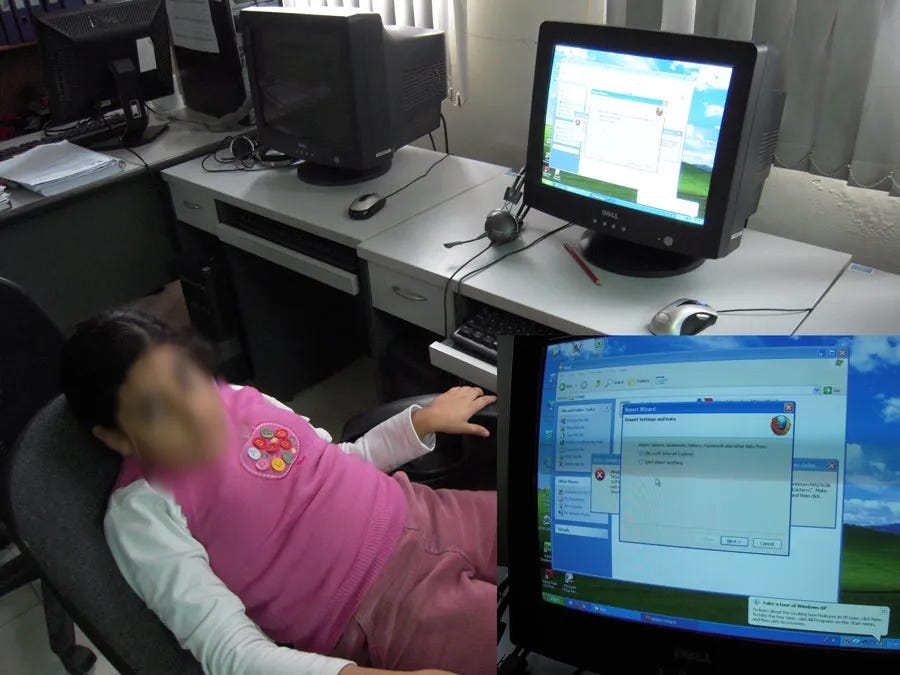
Eighteen years ago, on my first day as an international school computer lab teacher for elementary students, I watched an eight-year-old try to log on to a lab computer.
Before she could open the browser and start class, she had to click through the entire Windows XP “fresh install” setup sequence. Fifteen separate pop-ups requiring precise clicks; one wrong click invoked long spools of additional software installs. Most students did not read well, nor did they understand what the prompts meant even when they did. It was a nightmare.
No problem though, I thought at first. It’s just this initial login from summer maintenance; we just have to do that once.
The next class came in a period later. I was wrong. It was every login. Every student. Every class. Permanent. I was told by IT that unless all the computers were re-imaged—which there was no time to do—this was the reality. They had worked most of the summer making the computers work this way.
IT had implemented this in good faith. They were protecting the machines from USB viruses. They solved their problem and created ours—a janky time-suck to start off every single class.
IT’s internal priorities were security, system integrity, and making their jobs easier in an understaffed school. Student learning wasn’t part of their team’s communication loop, so it wasn’t part of their system design. No one was “wrong”; the infrastructure for a conversation to avoid failure for student learning simply didn’t exist.
The Hero Trap (Or: How I Made It Worse)
I was new to the school and realized there was little we could do in the short term. So, I “fixed” the machines each day by logging in for the kids ahead of every period I could. It took me about 10 minutes to prep the whole lab. Problem solved.
I’d turned a systemic failure into my personal daily ritual. The better I got at absorbing the dysfunction, the longer it survived.
This is what I now recognize as the first trap of educational technology work: individual heroism masking collaborative infrastructure failure. We are the people who make broken communication and tech systems appear functional—and in doing so, we make it more likely those systems remain.
The Escalation That Failed
Eventually, I stopped being the hero. I escalated as it was just too ridiculous and other similar symptoms of “siloed decisionmaking” were cropping up all over the schools tech infrastructure. I pointed out the “collaboration” problem directly—to the techs who’d configured it, to the Tech Director, to the Principal, to the Head of School.
The Tech Director understood, but said “local staff” operated quasi-independently; he was half-embarrassed but without pull. The Principal understood but didn’t have the bandwidth or context. Everyone else heard a complaint, not a systemic issue. I wasn’t surfacing a design thinking flaw; I was being difficult.
That’s when I started to understand: there was no shared space where “IT’s security needs” and “student learning time” could be weighed against each other. I was asking for a conversation the school’s infrastructure didn’t support.
Two paths, both failures:
Path 1 (Hero mode): Absorb the problem. Nothing changes. Burn out quietly.
Path 2 (Escalation mode): Surface the problem directly. Look like a complainer. Allies now? Too late.
Be more resilient. Advocate louder. I tried both. Neither worked.
I Stopped Calling Myself a “Tech Coach”
At my next school, I became an official “EdTech Coach”, but I didn’t stick to what the title suggested. I was not on the sidelines (the very definition of a coach), nor was I there to “fix” teachers or push only for “growth.”
I started thinking of myself as someone removing friction. Alongside training, I focused on connecting stakeholders before problems emerged. Instead of training teachers on tools they did not request, I built the communication infrastructure that let IT, Curriculum, and Administration actually see each other’s constraints regarding the tools teachers depended on.
In short—I stopped waiting for permission to do the work that actually needed doing.
As in all schools, there was always a lot of loose talk about collaboration, but interestingly, not one of the words in the allstaff slide decks or meeting norms changed any structures.
So, I set up the collaborative calendaring system with the Learning Support team when IT told the Dept. Head they could not look into it for “several weeks.” We just built what the department needed to start functioning in our ecosystem, not what IT wanted to build when they found the time to overengineer it.
Then, having shown myself a capable listener and collaboration partner with the Learning Support team, and having access to the LS collaboration calendar, I showed up to my first meeting to support the LS team and the teacher before anyone asked me to.
This action shift sounds small and a bit awkward…but it was neither.
This was the school’s first truly collaborative, regularly scheduled planning meeting for student support—held before the teacher’s unit began, and it was as if the seas finally parted.
Welcome to Assumption
At the meeting, the art teacher explained that he planned to require students to take quality photos of their projects throughout the unit.
“iPads, obviously—everyone knows iPads take better pictures,” he said. I knew there were some caveats to this—which iPad cart he had, availability, etc.—but I knew what he thought he knew.
I started to mention that student Chromebooks could do this, but before I could explain the pros and cons, he stopped me. Nope. He didn’t want my input. They were going to use iPads. He knew how to do it with iPads. To him, the “tech coach” was the person adding more complexity to his plate, and the last thing he wanted was anyone else telling him what else he needed to do.
I was fine with it, didn’t argue, made a few suggestions for differentiation possibilities and the meeting was a big success.
Then, I Tested the Assumption
The result? The Chromebook camera image was sharper because of its built-in scan/tilt image functions, and faster because each student already had everything they needed. The workflow of the iPad cart, the Google login times, the student retrieval and return of the iPads, all that device-switching chaos—it was all unnecessary.
The 10 minutes I took to test things saved at least a dozen cumulative hours of student busywork over multiple lessons across all his classes. Several failure/chaos points—20 students getting ipads, logging into each student’s Google Drive, upload, logout of Drive, replace the ipads in the right places—gone. Three steps instead of ten. Zero IT support tickets generated. Everything the students needed in a single 30 second video of the Chromebook scan/adjust feature.
He was slightly embarrassed for having been so certain there was “no other way.” He invited me to his own art show some months later, ironically titled “Welcome to Assumption.”
After that, everything shifted. He started calling me before things went sideways because I’d removed friction instead of adding more; his (and many others in education) impression of what “Tech Coaches” aka “IT people” do.
Here’s What I Learned
Schools focus “tech coaching” on the lowest-leverage points: training, apps, and devices. Meanwhile, the highest-leverage point remains untouched: the collaborative infrastructure that would let IT, integrationists, teachers, and administrators actually work together.
SAMR, TPACK, TIM—all the EdTech “frameworks”—falsely assume (and depend on) coherent, consistent collaboration processes. They are great destinations, but they mean little when there are no roads.
Every hour spent as a human workaround is an hour the system doesn’t have to change. Every crisis you absorb is a collaborative conversation that never happens.
You can’t scale individual heroics. You can only scale collaborative systems.
A Question You Can Ask Yourself
If you’re an EdTech integrationist, a technology coach, or a digital learning specialist—whatever your title is among the 80+ variations in the field—
Are you solving the real problems, or is your “heroism” helping to hide them?
Matt Brady has spent 15+ years in educational technology leadership across international schools. He is the developer of the Edtech Synergist Protocol, a framework for supporting instructional technologists in building collaborative infrastructure within K-12 schools.