
Does EdTech Coaching Work?
Visit to the EDU Coach Collective podcast...
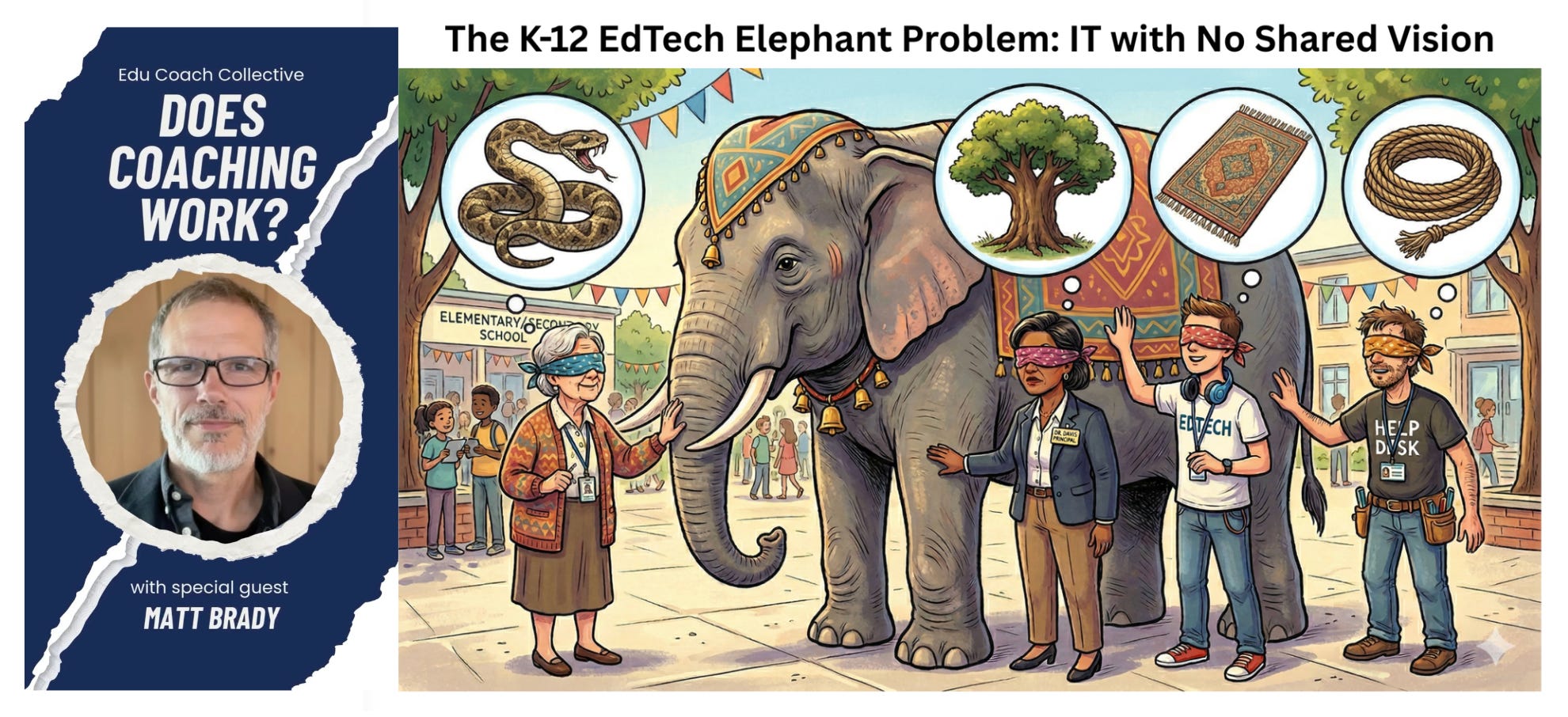
I was invited on the EDU Coach Collective podcast to discuss my research @ "tech coaching" and it's troubling relationship with value delivery in K-12 schools.
𝗘𝗽𝗶𝘀𝗼𝗱𝗲 𝘀𝘂𝗺𝗺𝗮𝗿𝘆:
𝘐𝘯 𝘰𝘶𝘳 𝘭𝘢𝘵𝘦𝘴𝘵 𝘦𝘱𝘪𝘴𝘰𝘥𝘦, 𝘸𝘦 𝘴𝘪𝘵 𝘥𝘰𝘸𝘯 𝘸𝘪𝘵𝘩 𝘔𝘢𝘵𝘵 𝘉𝘳𝘢𝘥𝘺 𝘵𝘰 𝘤𝘩𝘢𝘭𝘭𝘦𝘯𝘨𝘦 𝘵𝘩𝘦 𝘴𝘵𝘢𝘵𝘶𝘴 𝘲𝘶𝘰 𝘰𝘧 𝘪𝘯𝘴𝘵𝘳𝘶𝘤𝘵𝘪𝘰𝘯𝘢𝘭 𝘵𝘦𝘤𝘩 𝘤𝘰𝘢𝘤𝘩𝘪𝘯𝘨.
𝘔𝘢𝘵𝘵’𝘴 𝘸𝘰𝘳𝘬 𝘩𝘪𝘨𝘩𝘭𝘪𝘨𝘩𝘵𝘴 𝘢 𝘴𝘺𝘴𝘵𝘦𝘮𝘪𝘤 𝘣𝘭𝘪𝘯𝘥 𝘴𝘱𝘰𝘵: 𝘸𝘦’𝘷𝘦 𝘱𝘳𝘪𝘰𝘳𝘪𝘵𝘪𝘻𝘦𝘥 "𝘵𝘰𝘰𝘭 𝘵𝘪𝘱𝘴 𝘢𝘯𝘥 𝘵𝘳𝘢𝘪𝘯𝘪𝘯𝘨" 𝘰𝘷𝘦𝘳 𝘣𝘶𝘪𝘭𝘥𝘪𝘯𝘨 𝘤𝘰𝘭𝘭𝘦𝘤𝘵𝘪𝘷𝘦 𝘦𝘧𝘧𝘪𝘤𝘢𝘤𝘺, 𝘸𝘩𝘪𝘤𝘩 𝘩𝘢𝘴 𝘳𝘦𝘴𝘶𝘭𝘵𝘦𝘥 𝘪𝘯 “𝘣𝘶𝘴𝘺𝘯𝘦𝘴𝘴” 𝘸𝘪𝘵𝘩𝘰𝘶𝘵 𝘱𝘳𝘰𝘥𝘶𝘤𝘵𝘪𝘷𝘪𝘵𝘺, 𝘴𝘵𝘢𝘧𝘧 𝘣𝘶𝘳𝘯𝘰𝘶𝘵, 𝘢𝘯𝘥 𝘯𝘦𝘨𝘭𝘪𝘨𝘪𝘣𝘭𝘦 𝘨𝘢𝘪𝘯𝘴 𝘪𝘯 𝘴𝘵𝘶𝘥𝘦𝘯𝘵 𝘭𝘦𝘢𝘳𝘯𝘪𝘯𝘨.
𝘔𝘢𝘵𝘵 𝘴𝘩𝘢𝘳𝘦𝘴 𝘩𝘰𝘸 𝘩𝘪𝘴 𝘤𝘰𝘭𝘭𝘢𝘣𝘰𝘳𝘢𝘵𝘪𝘷𝘦 𝘱𝘳𝘰𝘵𝘰𝘤𝘰𝘭 𝘪𝘴 𝘴𝘩𝘪𝘧𝘵𝘪𝘯𝘨 𝘵𝘩𝘦 𝘧𝘰𝘤𝘶𝘴 𝘣𝘢𝘤𝘬 𝘵𝘰 𝘸𝘩𝘢𝘵 𝘮𝘢𝘵𝘵𝘦𝘳𝘴—𝘢𝘭𝘪𝘨𝘯𝘪𝘯𝘨 𝘵𝘦𝘢𝘤𝘩𝘦𝘳𝘴, 𝘐𝘛, 𝘢𝘯𝘥 𝘢𝘥𝘮𝘪𝘯 𝘵𝘰 𝘣𝘶𝘪𝘭𝘥 𝘤𝘰𝘭𝘭𝘢𝘣𝘰𝘳𝘢𝘵𝘪𝘷𝘦 𝘤𝘢𝘱𝘢𝘤𝘪𝘵𝘺.
𝘗𝘭𝘶𝘴, 𝘨𝘦𝘵 𝘢 𝘴𝘯𝘦𝘢𝘬 𝘱𝘦𝘦𝘬 𝘢𝘵 𝘩𝘪𝘴 𝘶𝘱𝘤𝘰𝘮𝘪𝘯𝘨 𝘢𝘱𝘱 𝘥𝘦𝘴𝘪𝘨𝘯𝘦𝘥 𝘵𝘰 𝘩𝘦𝘭𝘱 𝘒𝘎-12 𝘪𝘯𝘵𝘦𝘨𝘳𝘢𝘵𝘪𝘰𝘯𝘪𝘴𝘵𝘴 𝘮𝘦𝘢𝘴𝘶𝘳𝘦 𝘳𝘦𝘢𝘭 𝘪𝘮𝘱𝘢𝘤𝘵.
🎧 Pod: https://ow.ly/6Q5850YyBFX
📃Transcript: t.ly/-TJqs
Podcast Video: Here
(Originally recorded– October 31, 2025)
TLDR Summary:
Reclaiming Brain Cycles for All Stakeholders & Building Structural Synergy
The “Leaf Blower” Problem: Many EdTech initiatives create “digital noise”—simply moving tasks from paper to screen—without actually simplifying anyone’s workload or improving student outcomes.
From Compliance to Commitment: Success isn’t about forcing teachers to use new tools; it’s about designing “Computationally Kind” systems that work so well that teachers want to commit to them.
The “Yak Shaving” Metric: We need to move away from measuring “how many trainings” were held and start measuring how many redundant, irrelevant steps (the “Yak Shave”) have been removed from a teacher’s daily workflow.
Collaborative Infrastructure: Coaches are uniquely positioned to act as “Curatorial Journalists,” bridging the gap between Admin mandates, IT constraints, and Teacher needs to ensure the “engine is actually connected to the transmission”.
Building Capacity, Not Dependency: The goal of the Edtech Synergist Protocol is to move away from “heroic” one-on-one fixes and toward a scalable system that builds teacher efficacy and school-wide wellness.
Proactive System Design: By listening to teachers’ actual goals and testing workflows ahead of time, we can provide “headlights” for leadership to see where friction points are costing the district time and money.
Podcast Transcript: The EDU Coach Collective
Celine Thomas: Calling all instructional leaders, curriculum innovators, and dedicated classroom coaches—or whatever they call you! I’m Celine.
Katie Ritter: And I’m Katie. As coaches, we know the path to school-wide growth can feel isolating, with big responsibilities resting squarely on your shoulders.
Celine Thomas: That’s why we built this space. We’re opening the conversation to connect, collaborate, and bring a unified voice to the world of instructional coaching.
Katie Ritter: Elevate your practice with strategies that work.
Celine Thomas: And finally feel like you have a whole collective cheering you on. So let’s dive into this conversation!
Celine Thomas: Welcome back to the EDU Coach Collective, the podcast dedicated to empowering instructional leaders to drive transformative change. We often talk about the latest strategies and models, but today, we’re pulling back the curtain on a fundamental question: Does coaching actually work? And more importantly, does the system we work in allow it to? So today we have Matt Brady—we’re so excited to have Matt! He is a learning community builder, a digital innovation lead, and project change manager who worked in a US public school and a private international school for almost two decades as a teacher, a digital learning coach, and an administrator. Most recently, he led digital transformations for international school communities in Germany, Japan, and Switzerland. So we’re so excited to have you today!
Matt Brady: That’s fantastic. Thanks for inviting me. I’m so glad to meet you and be here.
Katie Ritter: Matt, I am so—I was telling Celine—I am so excited about this topic. It is something that I am also personally super passionate in. So I told Celine she might have to, like, tell me when I’m making the recording way too long because I’m just so stoked to talk about it and specifically the systems piece that you’re interested in. So you say, you know, in kind of the opening here, right, like: “Does coaching actually work?” So in order to determine if it’s actually working, right, obviously we have to look at some data there to actually make that determination. So in your opinion, what do you think is the single most impactful metric that any instructional coach should be using to, first and foremost, measure their actual impact, but also to be able to justify their role to leadership?
Matt Brady: So, it’s such a great question and just to answer it, I think I would step back just a second and—you just mentioned a couple of key words and as we were talking before we started, we talked about, you know, the definitions of words. And I think words matter in the end. And I think in a lot of times, especially with EdTech, the way that it’s been talked about for so many years—you know, we look at 21st-century learning and all these different kinds of, I guess, stand-ins for what EdTech sort of is involved in or is sort of responsible for. And I think one of the things that’s been really interesting in my work is looking at—undeniably, EdTech and coaching and integration and so on has been absolutely incredible in connecting families and teachers and admins and calendars and sharing. But I think what—when I came to look at that, you know, a lot of that is really digital administration and digital teaching. That’s not really digital learning per se. You know, there’s just these incredible pieces of contribution that Tech has made. And I think what ultimately I came back to about, you know, when we ask the question “is coaching effective,” I think absolutely it is. However, looking at the data about “what is technology contributing to student learning gains” and “how would we move that forward,” I think that’s where my focus has been because ultimately, you know, that’s why we’re there, right? We’re there for students and we’re hoping that they continue to learn and they grow into amazing people that do great things.
So I think, I guess just to clarify a little bit too around that... so, one of the other interesting pieces to come back to the words: You just mentioned the word “implementation.” And and that’s one of the things—and there’s nothing wrong with that word—you know, we substitute so many different words for what Tech is doing or how we do it. And this is one of the core pieces of my research that got me onto this topic in the first place was that when I became a Google Trainer, I recognized on the list there were 70 different names for who Google Trainers are. And I just wondered: How could that be that there’s this many different names for this role?
Katie Ritter: Matt, I don’t mean to interrupt you, but what’s so hilarious is when we launched this podcast back in 2020, our very first episode was “What is a Tech Coach?” And so in preparation for that, I sent out a tweet of “What is your title?” I got 200 responses; every single one of them was different.
Matt Brady: Wow. 200? See, now I was—thought I was actually kind of pressing the limit with 70, but it doesn’t surprise me at all that that’s... and so we’re going to eventually get around to your question. I don’t mean to sort of dance around.
Katie Ritter: No!
Matt Brady: Just to understand, just to clarify a little bit more because as we talked about, you know, my experience is in international schools primarily. So some of the language is a little bit different, some of the sort of workflow—you know, the work conditions are different because we’re often times just working for a single school, not across a district with multiple schools and so on. So, you talked about implementation and I’ve always made this distinction that a lot of times what happens in schools is things kind of stop at implementation. We implemented Google Docs and Canvas and Schoology, but to the extent that they’re actually integrated, that’s to me the question. Because it’s really easy—and I kind of joke about this—you know, a little bit of EdTech is a little bit like a leaf blower sometimes. It just is super loud, makes a lot of noise, but really just kind of moves stuff from one place to another. The problem’s still there, now it’s digital where we have the problem keeping track of the documents and so on.
So those—there’s these little bits and pieces and when you say “is coaching effective,” I think it is. However, kind of when we start to put these little things together—that the coach role is known as 70 or 200 different things—I think what makes it difficult to answer that question is that schools have a hard time supporting what they don’t understand. And I think, especially in international schools, there’s so much turnover in the roles—I mean of course the teacher stays consistent, admin stays consistent, we all know what an English Language Learning (ELL) or ESL... we understand that mode. But for coaching, it seems a little bit... it somehow is different, but for EdTech specifically—I know you guys deal with a lot of instructional coaching in general and I feel like I can see that much more deeply than I can with EdTech, just simply because the sheer amount of focus on the tools with EdTech. Whereas, you know, literacy coaching, they’re not breaking out special tape recorders and stuff like that for that; it’s much more mental.
So, my answer after all that—the answer is, and this is only my little narrow view, but if we think about all the stuff that coaches do, most of the time you’re trying to win. You’re trying to get more points. You’re trying to grow your lead over where you are now or, you know, some baseline and looking forward in the future. What I’ve found over time was I think the metric that I have used the most effectively is not about growth per se, but it’s: How well were you able to remove the factors limiting growth?
So... more and more words. But there is a difference in that, because there’s a difference between—you know, it’s not about doing things differently within the same model, it’s about actually doing different things. And so this can mean lots of different types of measurement, and this is the biggest piece right now that I’m working on is: How do you measure effectively and simply and visibly removing a factor limiting growth? So that’s kind of where I come from on this.
Katie Ritter: I love that so much! So many things... I had to start taking notes!
Matt Brady: It’s all online, you don’t—
Katie Ritter: No, I’m glad that you started with that, like, taking a step back in that introduction because I agree with you so much. I mean, like I said, 200 different titles. And I also agree with you that I feel like when it comes to content coaches or general instructional coaches, the nickel seems to drop a lot faster for folks about what that coach does and how they support teachers in the classroom vs. our tech coaches. Could not agree with you more there. I mean, we talk so much about the importance of role clarity, one for the coach themselves so that they do the work that they should be doing that actually leads to, like, coaching impact, but also for everyone else. So I love that you started with that because I think that’s spot on. And I also totally agree with what you said about, like, it’s hard for the tech metric vs., again, general instructional coaches, because I think, you know, what we often see is that the instructional coaches, dedicated content coaches, right—like literacy coaches—are sitting down with the (in the States) English teachers and looking at student test score data. Right? It’s easier to look at the data, work with them, improve, and then again look at that student data to see if it’s improving. We can come to a conclusion that obviously the instruction’s improving if the test scores are improving. Whereas like the tech coaches, we aren’t necessarily always afforded that same opportunity to sit down and look at the student data with the teachers. And I think some of them would be willing to do it if asked, but I also think there might be a little bit of, like, “Whoa, that’s not necessarily your lane, like what are we looking at?” So I can appreciate the search for a good metric that you’ve been going through because it’s not—you know, our goal, we all know as a... I’m just going to say “Tech Coach,” right? Whatever your title, we’re going to use that for today. Our goal is always to improve student learning. Right? That’s where our passion came from. We came from the classroom too, we just happen to be tech-savvy so now we’re helping you too! So our goal’s always student learning, but it is funny because we’re not always afforded that same opportunity to look at the data. So I think that’s great.
If I can dig just a little bit deeper: When you say you’ve been—and I can see how it’s hard to show that you’ve removed something—but so when you’re thinking about removing barriers, what are some of the things you’re looking at or the data that you’ve collected as a part of that metric to show that you’ve removed those barriers to learning?
Matt Brady: I mean—so, just to... there are a lot of separate little pieces, but I think just to come to one of my favorite ones and it’s—it’s got a name, it’s called the “Yak Shaving.” And yak shaving is generally a workflow description. And if you’re not familiar with it, it comes from the fact—as simple thing of like, any time somebody has to do, you know, let’s say we have a task we need to do, and in this case they call it, let’s say the yak shaving just simply means that you have to do A, B, C, and D in order to actually do the thing you want to do which is E. And so this the whole concept is that you think about a teacher’s workflow. Like, I—you know, almost every school I’ve been in, they have a Student Information System (SIS), they have an LMS, and those things don’t quite talk to each other. And then there’s also possibly a, you know, a disconnected curriculum tracking system. And what inevitably happens is that when the teacher has to input grades, for example, they have to introduce another Excel spreadsheet to actually somehow get the grades from here to here over in here. And so yak shaving just suggests like when you’re given a task to do X, that that means that you in to do that, you actually are doing these completely irrelevant things, you know, sort of toward that goal, instead of actually doing the thing.
And so part of what I’m looking at, what I’ve worked on as more of a Project Management approach to coaching, was what—look at the process maps for how these, you know, grading or even simple things like submitting PD forms. You know, how many different steps are teachers being asked to do and spend time on to do all these bits when instead of being directly able to just enter your grades into the system, you know, you’re ending up having to do these other—”yak shave” effectively—which is some, you know, relatively of course it looks like it’s moving towards that but why wouldn’t you just enter the grades in the system? So that is one of the big metrics, just looking at something where where you’re not—you’re doing something apart.
Celine Thomas: Can I jump in before you... I just—so many things. One, will you spell “Yak”—are you saying yak?
Matt Brady: Yes, Y-A-K. A yak, like a buffalo.
Celine Thomas: Okay. One of the things I always think about and share, and in the context I always share this with coaches when I’m doing work with them, this quote: “Every system is perfectly designed to get exactly the results it gets.” And I’m always thinking about that, like, if we’re having problems, how have we designed the system to lead to these patterns of problems that we’re consistently seeing? Right? So all of the “app sprawl” of having teachers go from here to there to here to there, I think is so real. I really appreciate that perspective of—I’ve never thought of it like that for teachers, of how do we remove extra steps for them in the way that you just described it. I think it’s really smart. And ironically, I just had a conversation with a colleague about our forward-edge employees for trainings we’re doing around the registration form and having deadlines. And I’m like: Is the point that we want people to get there or is the point that we want them to register by this deadline? Because I think we’re creating a barrier to just get them to show up. So how can we rethink that and just, like, make it as accessible as possible? So right right along the lines of what so—that’s just, like, ringing home to me because I just recently experienced some myself.
Matt Brady: Well—yeah, and we all do. And it’s not something specific to EdTech or schools or anything. I mean, this is system design in general, it’s kind of just general principles. But what you just jogged a little piece for me: This soundbite about “Are you designing systems to make it easy to comply?” And with the mandate or the initiative or the protocol, that’s really what this measurement that I’m trying to find out comes down to. And and you can call—I’ve heard this called different things. It can be called “Computational Kindness.” Like, how much hoop-jumping and do is it you have to go to the email to the website to click here to open this thing? And I think all of that cognitive overhead builds up and because so many of these processes that teachers have to do that aren’t really about—they’re not about it’s the digital teaching part, it’s not about student interfacing, it’s not about designing, you know, curriculum and so on, it’s just the sheer administration of being a teacher. Those are the pieces that oftentimes you can start to look at first to say, are you actually making a difference in the amount of time that a teacher has to be a teacher, rather than a, you know, sort of “techer.”
So, and again kind of comes back to the—so you’re are you designing for people to easily comply, but also at the same time, what you’re really trying to do as a coach is to get them to commit. You know, so you want commitment, not compliance in the end, because people kind of resent compliance. But what you’re trying to do is get them to commit. And that’s again where shifting this lens from looking at, you know, EdTech and coaching and so on as a growth function... what really people want first of all to get them to grow is they want their systems they have right now to work. Hands down. I mean, don’t give me super-duper, you know, App 2.0, I want the apps we have right now to work first. Then they’ll gladly commit to the growth part. But I mean that—so, now, at the end of the at the there you can do them both, this is not an either-or thing, right? So anyway that—this choice of or sort of distinction between commitment and compliance is really interesting one, and I think ultimately we want to be able to comply as easily as possible, because some parts of it is I mean you just these are the things we have to do.
Katie Ritter: Absolutely. I love the “Computational Kindness.” I’m just going to circle back because there was a lot of things there too that I related to as a coach, especially going back to talking about, like, how do you morph into the coach that is needed, especially being that I’ve in my recent district gone in as a Tech Coach, but recently it’s been all about data, like in every single building. So it’s like now I’m in these data meetings and they’re like, “Oh well, what’s the best tech tool that’s going to help achieve this this and this goal?” But then there’s the instructional input that I also want to kind of intercede. So it’s just interesting to see, like, what ways, like you were saying, like how do we streamline the ability to have all these aspects of coaching into more of like a project structure. Like that—I’ll go back to the other thing, but we can go on to the next question.
Matt Brady: You’ve made a really interesting point there, and the idea that I think that I think we’re coming to or I’m coming to is that what you really want to show—and data can be a part of this—is that I think part of the challenge with being a coach in the way that it’s currently done in in an EdTech coach is that, you know, a lot of it is about tools. I mean, that’s that’s the stock and trade of what a lot of this is. But I think what a lot of times it feels like what we’re doing a little bit is building dependency. That you’re the person that’s going to be able to tell them to show... and I think to kind of come back to the first question or the questions, what I think that I’m trying to sort of come to an understanding or a system, you know, consistent system is that: How can you show leadership that you’re building capacity versus a dependency again on you? That that you’re the only person that can come in and, you know, make the sun shine. So part of that element of removing these factors limiting growth first, that allows for the less dependency because then people have bandwidth to actually, you know, they feel like this is actually going to be worth it. The bits that I actually really need to do, I feel pretty confident about, it’s relatively smooth. You know, it’s just... so I totally understand.
Katie Ritter: I mean, we are—it is so often focused on the tools for the tech coaches. And so we often, you know, preach on this podcast and the work that we do with coaches: like, pedagogy first, instruction first. Like, what’s the purpose? What’s the outcome? Then follow it, you know, with the tool to to really drive that you’re there to support that instruction and those students. And I don’t know if you’ve seen it, Matt, but we actually published—it’s called the “Core of Coaching Framework”—and Domain 3 is all about that piece that you’re hitting on of, like, building that sustainable capacity because no, you know, we all want to leave a mark, right? Like we all want, we all hope that we are coming into education to make kids’ lives better, right? And then we become a coach probably because then we find this passion that we have, you know, that has grown from not only students but supporting adults to exacerbate our our, you know, tiny little impact and in some small way and help the teachers then impact their students in a bigger way, right? So that that can’t sustain if they have to come to us with every single question and seek every single thing. So that building capacity is so important, so I just love that you touched on that.
Celine Thomas: I know, I’m like Celine, it’s okay, we’re going to have this recorded for later. I know the social media channel’s going to love all these, like, quotable nuggets you’re throwing at us! I’m over here thinking about structural changes in school districts. What structural changes are essential to transition coaching from, like, a vulnerable, soft thing to something that’s more stable, non-negotiable—something that the school district actually needs or wants?
Matt Brady: Yeah. So, just—I’m going to repeat myself just a little bit because I will talk—I think part of that is is to be able to demonstrate how you’re building capacity. And I think what we’ve typically done when we’ve we’ve answered that question or tried to demonstrate is “how many trainings did we give,” “how many people logged on to the app” or “how many people are participating, using this particular system”—you know, looking at analytics in that way, and there’s absolutely nothing wrong with that. But I think one of the things that too that we could add into that is: How much have you been able to bring EdTech, IT, and teachers and coaches and admin together in collaborative meetings? I think that’s even just that metric: How often have you been able to meet with these different groups rather than just teachers?
And and I we come back a little bit to this the ideas, you know, are teachers there to be passive recipients of our PD or are they there to actually help us to help them? And here’s—here’s the thing that most blows my mind about everything and and I kind of want to talk about this today. I don’t know if it fits. But if you think back to the early 2000s when SAMR, TPACK, TIM, PICRAT—all these things came out, you know, now it’s two decades ago. All of the frameworks super valuable. For me, the simplest one has always kind of been Triple E now (Engage, Extend, Enhance). Really cool, really useful. But here’s the thing about that is that there has not been a single school that I have been to that has any consistent understanding, setup, you know, collaborative process in place to actually make sure those conversations—to talk about what how the tech leads... or sorry excuse me—so the learning leads... it just blows my mind that, yes, we have all these frameworks and things, but there’s no there’s no connection from the engine to the transmission. It’s “Yes, here’s all this wonderful stuff,” but we didn’t... the whole idea about “when does this conversation happen?” I mean other than the sort of—and this is where I think the problematic piece about being a coach a little bit... back to words. Where does a coach—what’s the definition of a coach? What do we think about when we think about coaches? The person on the sidelines. And that’s not—that’s not where we are. That’s not... we’re not over there just kind of blah blah blah. You hopefully should be right in the mix, talking to teachers about their lessons right there. So I get it, but but at the same time I’m just and then you come back again—there’s 200 different titles. So I think part of the structural piece, you know, or this could be looking at: Well, what’s the right name for this role?
You know, in my very narrow view is that, you know, I come looking at it from Project Management. I’m much more of a Servant Leader in project management because you’re there to enable the stakeholders. And in EdTech’s case, it’s IT, it’s admin, it’s teachers, and you. But if those stakeholders aren’t there at the beginning of the conversations, then you’re just kind of piling things on assumption on... so, I mean structurally, like you kind of mentioned Celine, like we could talk about this forever because I think it’s we’ve EdTech and the and the sort of the machinery of the process has grown so big and so much that we never really ever got back to first principles to say, “Hey, does this actually what we need? Is this the best way to do this?” So yeah, there’s a lot of little pieces in the structure, but I think it’s, you know, a little bit of the the name in the roles. The other bit too is that, you know, you’re really as a coach from my view is you’re building collaborative infrastructure. You’re taking admin initiatives, you’re trying to figure out work with IT to actually make sure that those systems that the initiatives called for actually work with the workflows and the tech that the teachers have, but also then you’re working with those teachers to say “Well, this is the way you do it. Oh, you’re a Modern Classrooms approach teacher, or you’re EduScrum or whatever specific kind of thing they do.” Hopefully you’re trying to facilitate their process rather than, “Hey guys, guess what? We’re all going to do things in rows now, it’s all about...” you know, I think that education—we get in that cycle of like and everybody’s just like, “Oh god, here we go again. It’s all different this year.”
Celine Thomas: Yeah. I’ve noticed a little bit of facilitation definitely coming out of my role this year for sure, especially when it comes to data. So that that makes sense.
Katie Ritter: Yeah. It’s interesting too what you said, Matt, about the—you kind of started touching on it and I loved how you said “collaborative infrastructure.” I love just the visual that that paints about what coaches do. I’ve always felt like coaches have this really unique, especially a tech coach, just have this really unique position to, like, connect stakeholders. But I love the way you said building collaborative infrastructure.
Matt Brady: Just really quickly Katie, I’ve been so frustrated with this process that I actually... this is the model of the collaborative infrastructure of what I do in my job. And if you notice, those four different islands on the, you know, we’ve got admin, IT, coaches and teachers, and then in the middle basically you have this “X” because the work that we’re doing often times what you’re trying to do is bring all those four things together and hopefully tighten that because every—all of the the real nitty-gritty of where things happen are all on the edges, right? The IT’s got their way of doing things, admin does their thing, we do our thing, and the teachers do their thing. But ultimately your real job as a tech coach is that it’s you’re the one that’s kind of making sure that everybody’s—those things are actually working. And here—and so the reason that I think it’s valuable to talk about that collaborative infrastructure is because, you know, it gives people—people need a visual. They—how do you how do you sort of understand your relationship to everybody else in the system if you’re if it’s just—and we come there was a great what’s it called? The Elephant Problem. Right? Where you’ve got four different groups and they’re each touching the elephant, but like one’s got the tail, the other one’s got the trunk.
Katie Ritter: I literally used this image in yesterday’s workshop!
Matt Brady: Did you? I mean it’s very true constantly. Everybody’s looking at this thing and, “Oh no, this is all about it’s working great!” but just depends on where you are.
Katie Ritter: Yeah. It’s a rope, it’s a tree, it’s a wall. Scale back, it’s the elephant. Yeah. Oh my god, if you can send us a photo of that so we could use that, like, with this podcast, because if that’s not the best visual I’ve ever seen of, like, how uniquely situated coaches are to bring these groups together, that is awesome!
Matt Brady: It’s funny because that those that is literally there’s a story about how that came to be is actually probably the more interesting thing than the device itself, but really it’s those—it’s a combination of two failed Christmas presents that just never—they were not failed, but they just never got the traction the way that... you know, my my daughter she she gave it a try, but it wasn’t a big thing and I kind of just sort of had these parts and pieces and I’m like the things that were happening in the background. So for me it’s been helpful just to try to put keep my thoughts together and how does this work.
Katie Ritter: Yeah, I love that. That’s hilarious. I’m going to see what my husband’s built with my failed Christmas presents. Also—so thinking about, so we’ve kind of talked about, like, the structural changes and thinking about some of that, right, but I do believe there’s more in our control to help move that along, right? Like I think your visual of the interconnected and collaborative infrastructure that we can build just kind of proved that. But at the same time there is certainly something things out of the coach’s control. So I want to shift very much to thinking about: What is within the coach’s control, would you recommend to shift their work from just one-on-one teacher support to being able to, like, develop this wide-spread sustainable infrastructure with the teachers so that they can carry on and implement beyond us always needing to be there with them and support one another? What like is your like biggest piece of advice you would give coaches?
Matt Brady: And this is—this is one of the, I guess you would kind of say is that you’re a little bit shifting to less—you’re kind of what you’re talking about is teacher collective efficacy where they have this belief they can do it on their own. They are confident in their systems and their tools. I think what I’m finding in that model was kind of a good example is that what I’m hoping—I don’t think this actually exists as a statistic but—or as a, you know, sort of parameter of data collection—but what I have felt works is to actually develop Cross-Functional Efficacy. Where because you know that those stakeholders the teacher are working so closely together on any one of these initiatives whether it’s, you know, just the just the core function of our learning management system and a student information system and how all this stuff goes. How well are those stakeholders’ needs and goals represented by the system? So for me, I look at it just as much as I I want one-to-one with the teacher, part of that is actually taking those conversations and when I see a trend with teachers that are saying, “Hey, we don’t like the way that the iPads do this” or whatever, documenting all those pieces and then that becomes the next conversation with the IT guys to say, “Hey, is there any other way that we can do this?” It’s called Curatorial Journalism. Where you’re taking bits and pieces from all these different little media or, you know, you’ve got your tutorials and your tips from your groups and then you’re listening to the teachers and then you’re finding out, you know, looking about “What are the data from our parents’ survey suggest?” or whatever and you’re compiling all those to kind of make a case—all the time in this case might be to admin about, “Hey, this is not working for them, this is what they say about it.” I think that ultimately sort of helps teachers in the end because you’re constantly working to just to listen to them about what’s... you know, rather than the sort of—it again is removing those factors that are limiting growth so they’re with because we we I think teachers do get tired of of the growth thing. Right? I mean we see it in our culture, we see it everywhere. We want to grow, we want to get bigger, we want to get faster and better. But it’s exhausting. So and part of that—I mean I guess this is the thing is like you as a coach you can’t scale your heroics either to be able to be there one-on-one with every teacher or whatever but you can scale a system if you get it working. So mapping the mapping the friction points and things and just making that a part of the conversations that you have with these groups. To me, those are the kinds of things that contributes to wellness with teacher... you know, like where you start to get you’re actually able to shift these this belief within the group that, “Yeah, we can work together and actually make this stuff work” rather than sort of against each other. And I think...
Katie Ritter: When you—you mentioned something about folks working closely together on some different initiatives and it immediately made me think of: have you ever seen that image where it’s like there’s a big valley and on the, you know, on one side is are folks who are building a bridge and they’re halfway across and on the other side are folks building a tunnel and they get halfway across and it’s not until they’re both halfway across that they realize there’s already other people working on a way to get across? And that is just like such a visual for me about what I observe so often in education and is just like every so many people are working on accomplishing the same goal and even within the same school system. I think coaches have, again, like this really unique position that we have to, like, wave the white flag and, like, pull people to the table when needed in the way you said about, like, collecting data and being able to bring that to people. I I think coaches absolutely do that, but I just wonder like what about visually mapping that information for admin? But I wonder about, like, visually mapping it out, almost like your little system over there for the the infrastructure—like, would that help admin see like, “Oh wow, this is a lot of—this is a bigger problem, right? We’re connected to so many different things.”
Matt Brady: Yeah. I mean at this point, you know, with the frustrations that I have had of of having to to hope get time with principals and so on to to even get eyeballs on on anything is is often a big challenge, right? So much of the focus is on day-to-day and because I think Tech has gotten the it kind of comes back to a little bit of the leaf blower thing: it’s sometimes so loud and forms such a big function of what we do as I think there’s a little bit of sort of Chicken Little or something about you have to be really careful about how you sort of present this kind of stuff. I think what I’m looking at is these—ultimately people listen to stories. You know, that’s that’s how we pass things on. And I’m that’s where I kind of mention that bit about curatorial journalism, meaning like you’re you’re constantly looking at the stories from these people of what’s really happening and I I haven’t I don’t have the answer to that yet but I feel like there’s got to be a mixture of the demonstrating that you’re able to build capacity that you’re removing a certain amount of teacher time. You know, that eventually if you have to translate into that into money—you know, “Okay so we if we change we changed this workflow process so students don’t know no longer have to do the three steps, well if you multiply that out by well there’s 472 students, they no longer have to do this every that’s X amount of minutes and teachers blah blah blah.” I mean you can calculate that. I think but the challenging part about it is is that we haven’t there’s been a—we haven’t felt like we’ve had to do that. You know, we talked at the beginning of the program about how do we justify or our these positions and it’s a funny it’s a funny place to be to be hired for something and then justify it. It’s a strange and this is where we we occupy this little occluded middle of between these different groups. So you have to kind of make yourself visible but it’s weird that we have to keep doing kind of the same thing all the time. And I think about this with, like, coaching menus. You know every year all the menus come out. “This is what we do, this is where we can blah blah blah.” It just seems like at some point isn’t that menu going to go away?
Katie Ritter: Yeah, like don’t they have it memorized? I think administrators and and IT guys should also have to do it every year. Anyway, so—
Celine Thomas: I’d be interested to know, like, what ways you’ve collected data to either like identify issue or workflow with teachers or students. Like what are some like personal examples of things that you’ve done that you’ve seen that were successful?
Matt Brady: I’ll give a specific example: We have Chromebooks in the middle school and we also have iPad carts. I have an art teacher and he’s really excited, would loves to take pictures and so on but he’s also he’s got, you know, Grade 6, 7, 8—all these classes so everything has to be super, you know, as quick as possible. One of the first forays into testing this process of trying to get in front of lesson planning, we were talking about “Well, how are we going to run this unit and how’s that going to work?” and he was his in his assumption was, “You know, we’re not going to use the Chromebooks because it’s too too wonky with flipping the book and blah blah blah and trying to...” he’s like “we’re going to do iPads.” But I and you know on the surface that makes total sense. But when I actually went and looked at it afterwards, I took the iPad and the Chromebook and I calculated all the time for switching Google Drive login, so kids forgetting and which iPad and blah blah all that kind of stuff. And but the but the kicker was is that when I went into the Chromebook, all of the wonkiness about the Chromebook went away when because it has a scan function which will actually take a look at and cut out all the pieces, you know, extra stuff and actually made a better image than these better resolution iPads.
So in the end, just being able to listen to the teacher, what they actually wanted to accomplish, and then take the time to just do the testing. Like look at it and go, “Okay here’s—and then I just presented it back to him.” I said—it was a two-slide Google Slide deck. I’m like “Here’s the process with the iPad. Here’s the calculated time cost switching, you know, having to have the iPad cart in the classroom and blah blah blah.” And he was flabbergasted because he’s like, “Yeah, the...” and he was blown away because he just assumed that “Yeah, the iPad’s got a great camera, it’s much easier for the kids to handle.” But when you look at the total workflow—and I think that’s what what we’re the only ones that really have a good idea of that because we we understand a lot of people just don’t figure in the fiddling cost of oh my gosh the way that the logins work in the iPads with Grade 7 because of the blah blah blah. You know, those are the kinds of things where the value of the role comes in, is that you can if you can just actually get that ahead of time, then you’re not fighting fires all the time. You’re just you’re proactive rather than reactive. And I think that’s if anything kind of comes back to the SAMR and TIM and all these kind of things—all that’s wonderful, but you can really make such a big difference too just by making the basics of what we already have work. And people—and he was kind of over the moon about the fact that all of this infra—you know, all the reservations of the iPad carts and having to go and do all those kind of things, that just didn’t need to be done. And I think that people appreciate the fact that you can kind of shine headlights on a place that they just if they were to have to do it, they’d just say “Forget it, I’m just going to just have the kids hold it up” or whatever. That’s one example.
Celine Thomas: Yeah, that’s really good. Yeah, I feel like I notice once I started being more proactive versus... I think when I first started coaching I was like, “Oh, I’m just going to give you as many solutions as I can. Like we’re going to fix it as soon as possible.” But like your just explaining that approach of: it’s okay to sit back and like let’s lay out and then pick the one simple solution that’s usually the easiest thing in the book versus going about and just reaching for things is super important.
Matt Brady: But it took to get that meeting to happen for the first time was I connected EdTech to the MTSS (the multi-tiered support), and that even to do that was me lobbying to say, “You know, just get EdTech in with that group.” You know, I’m just like constantly advocating for like: I’m not going to—and I think this has been part of the problem because the mentality of inviting the EdTech person means that they’re going to, “Well, have you guys seen this though? This if you just do this, all we have to do is...” you know, and it’s like where you’re going to sort of dominate the thing with your tool. And I just I just feel like you’re we’re much better off a lot of times as listeners and then... you know, my role in the meeting was almost nothing. I just came back afterwards and said, “Hey, this is what I looked at. Here’s what do you want to do?”
Katie Ritter: Matt, as we kind of wrap up here, is there any kind of last words that you would want to share that we didn’t touch on? And I definitely want to make sure folks know how they can find and connect with you.
Matt Brady: I have all sorts of little notes. I appreciate your patience with my answers. I’m definitely one of those people that is, you know, as wonderful as it is to be able to talk and interact with people, I often times need to kind of come back to my little shell to think things over because I have, you know, so many different ideas and things come up when people are talking. But I but I really—it’s been really a pleasure to kind of listen to you guys and try to both understand sort of where your perspective... because it’s very close in so many ways to obviously what I’ve experienced, but also, you know, thinking about “what are the important things that are different or that are interesting that are emerging that we can...” and obviously, you know, these ideas about little models and... so I just really appreciate the opportunity to do that.
Katie Ritter: Oh my gosh, it’s been amazing!
Matt Brady: I guess there were certain little bits and pieces, right? We already touched on leaf blowers, so you you got that element. I think the whole idea of the EdTech piece, what we talking about in measurements and so on, you know: our accountability and being able to demonstrate that accountability. I hope that we can come up with some better wellness sort of metrics or ways to measure that because I think so much of what the real role is is if you’re really doing it as a coach, you can make someone’s life so much easier. And that can be everything from, you know, offering to to write the email to IT for them when the smartboard is not working and all these there’s so many different ways that just contribute at the end of the day to... you know, go to the principal to go, “Well, I’ve for 14 people I wrote the email to IT instead of them having to sit there and in even though that those kind of elements are so huge sometimes because your ability to explain what exactly happened rather than ‘My smartboard doesn’t work again, please fix’.” You know, you can do those explanations. And that the challenge of figuring that out I think is the core of sort of what we’re talking about about this accountability piece. Building the infrastructure I think that makes—I call it the School, but it’s really all of us: the admin, the IT, and teachers—that that afford makes visible the system so we can be more accountable for the things that happen within it. You know, we’re all looking at different perspectives. And so having this kind of common language to come back to—so important.
And that’s kind of what I’m working on, and people can—I write a bit on Substack and I have a website and I publish a little bit on The International Educator. And those those things are so—the addresses are so long that no one would remember. Maybe we can drop those in there, but I write at Edtech Synergist. And Synergist is the name hopefully what I came up for is this piece: Like, what are we really doing? We’re trying to build synergy between these four groups so we have something a little better than the sum of the parts.
Katie Ritter: Absolutely. Thank you so much, Matt. This was truly a joy.
Celine Thomas: Thank you for being a part of the EDU Coach Collective today. If you found value in this episode, the best thing you can do is share it with another educator or leader who needs to hear it.
Katie Ritter: You can also connect with us on social media. Just look for The EDU Coach and let us know your biggest takeaway or what topics you want us to unpack next. New episodes drop every other Tuesday. Be sure to subscribe and leave us a review wherever you listen to your podcasts so we can reach more coaches just like you. Remember, you are not on an island. You are part of a powerful movement. Now, go coach fearlessly!